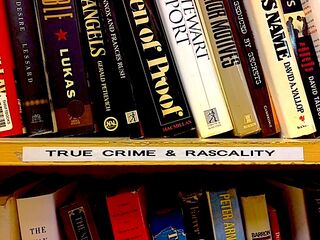
 Source: K. Ramsland
As a writer for "The Crime Library," which anchored the Court TV website for several years, I read many books on crime, specifically on murder. Recently, I was asked by Ben Fox to contribute to the Shepherd book discovery website, an online version of a bookstore that includes notes from authors guiding readers to their favorite books in certain categories.
“I want to help readers bump into books they would otherwise not find,” Fox told me, “and help them follow their curiosity to new places. Authors illuminate our world, take us on faraway journeys, and entertain us. One of my long-term goals is to help authors market themselves and give them more time to write.”
For the Shepherd site, I selected my top five single-case serial murder investigation books. While looking through my library to make this list, I noticed books I like that cover crime history or multiple cases. I thought it would be worthwhile to list a few for readers who are also crime authors or researchers.
6 favorite crime history books
What follows comes from my 25-plus years of immersion in murder. I picked my favorites (not listed in any particular order) for their narrative quality, which makes them highly readable. I did not include encyclopedias, and this list is not exhaustive. Some of these books inspired me to write Beating the Devil's Game, The Human Predator, The Devil's Dozen, and How to Catch a Killer.
The Century of the Detective, Jurgen Thorwald (1964)
Starting with French detective Eugène François Vidocq during the early part of the nineteenth century and running into the early twentieth century, this comprehensive history of crime introduced me to groundbreaking scientific innovations in the forensic arena. Thorwald covers milestones in identification, ballistics, toxicology, and medicine, often via sensational cases.
The New Evil: Understanding the Emergence of Modern Violent Crime, by Michael Stone and Gary Brucato (2019)
This impressive team of clinical experts (a forensic psychiatrist and a forensic clinical psychologist) has gotten as close to extreme offenders as anyone ever has. Building on Stone’s 22-level Gradations of Evil Scale, they explore shocking acts of depravity within the context of cultural and sociological influences. They looked at hundreds of cases of serial and mass murder, including those committed by kids. I once saw Stone’s impressive library of crime books (settled on bookshelves he made himself). It’s clear he’s done an enormous amount of research in this area. Stone and Brucato have both spent decades evaluating child abusers, rapists, and killers, as well as researching the most perverse acts that human beings can dream up. In this book, you’ll find examples for all 22 categories.
The Quality of Murder, edited by Anthony Boucher (1962)
“This is a sampler of murder,” states the introductory line of this “fact-crime” anthology that spans three centuries of American crime. Members of the Mystery Writers of America compiled the 24 cases. The collection is a “responsible attempt to study human nature in action under the most terrible of spotlights.” Among the contributions are well-known cases like H. H. Holmes, Lizzie Borden, and Ed Gein (written by Robert Bloch!), but they’re mostly less familiar cases, selected in part for the way they shed light on their era.
Murder Cases of the Twentieth Century, by David K. Frasier (1996).
Frasier, a reference librarian at Indiana University, created this comprehensive source based on 280 of the most famous serial killers (convicted and accused) through 1992. He includes both American and foreign killers. Each entry includes birth and death dates, aliases, murder locations, weapons used, number of victims, and a list of films or plays about the case. An appendix lists cases by classification.
The Serial Killer Files, by Harold Schechter (2003)
Among the first crime historians I read was Harold Schechter, a professor of American Literature and Culture. Basically, anything by him has been meticulously researched. In my list for the Shepherd site, I included Schechter's book on Belle Gunness, but he also has penned numerous other single-case books. This compendium is encyclopedic but with a narrative format. I included it because I wanted a book from this writer whose been a significant contributor to our understanding of historical serial killers.
Law and Crime Essential Reads When Parents of School Shooters Face Legal Liabilities
 Why Gen X Parents Are Afraid of the Wrong Types of Crime
American Serial Killers: The Epidemic Years 1950-2000. Peter Vronsky. New York: Berkley. 2020.
Crime historian Peter Vronsky, the author of several books about serial killers, offers a theory about specific social factors that spawned a “golden age” of serial murder during the 1970s and 1980s. Since he focuses almost exclusively on sexually compelled male offenders, the title's misleading, but Vronsky’s scholarship for case analysis is nevertheless impressive. He writes with an accessible rhythm, offering history and sociology balanced with true-crime detail. In places, the storytelling is exceptional, with descriptions that border on literary.
The book is a series of extended true crime tales that show how the sins of the fathers and the impact of stressful social conditions negatively influenced a generation of sons. The making of a sexually motivated serial killer, it seems, is the result of a violent heritage passing from one generation to another, “each crippling its young, leaving behind, at best, a crop of abused and maladjusted individuals, or at worst, a series of raped and dead murder victims.” The Great Depression, World War II-era parental traumas, and the easy access of true-detective and men’s adventure “sweats” became “transgressive scripting” for domination fantasies. As these dynamics lost force, Vronsky opines, the numbers of serial killers and their victim totals have declined. Should such a “perfect storm” of factors occur again, there’s trouble ahead. This book certainly makes you think.