 Possibilities and unanswered questions are not sufficient substitutes for scientific evidence. Source: Guy P. Harrison
One of the great mysteries of the cosmos is why belief in ancient astronauts is still flying high. How has the idea that advanced extraterrestrials tinkered with our timeline not crash-landed by now? According to a 2018 study by Chapman University researchers, 41 percent of American adults believe it.1 How many more years will this affront to the entire field of archaeology continue to orbit our species? How many more human minds will be abducted?
Responsibility for this ongoing crime against reason rests primarily on two sources. The first is Erich von Däniken, author of the wildly popular 1968 book, Chariots of the Gods? (the question mark in the title was dropped in later editions). It has been translated into more than 30 languages and has sold tens of millions of copies.
Von Däniken, a former hotel manager with convictions for embezzlement, fraud, and forgery, turned his bestseller into an industry. To date, he’s written more than 20 books that are variations on the same claim and inspired countless copycat books from others. Reality, however, is not a popularity contest. All extraordinary claims must be judged on evidence, and the ancient-astronaut “theory” has none.
It is possible, of course, that aliens really did do everything that every believer claims. Perhaps they did genetically upgrade australopithecines or Homo erectus, show us how to make fire, introduce art, inspire belief in gods, and teach ancient Egyptians how to stack really big stone blocks. But until someone presents a solid scientific case, it makes no sense to believe any of it.
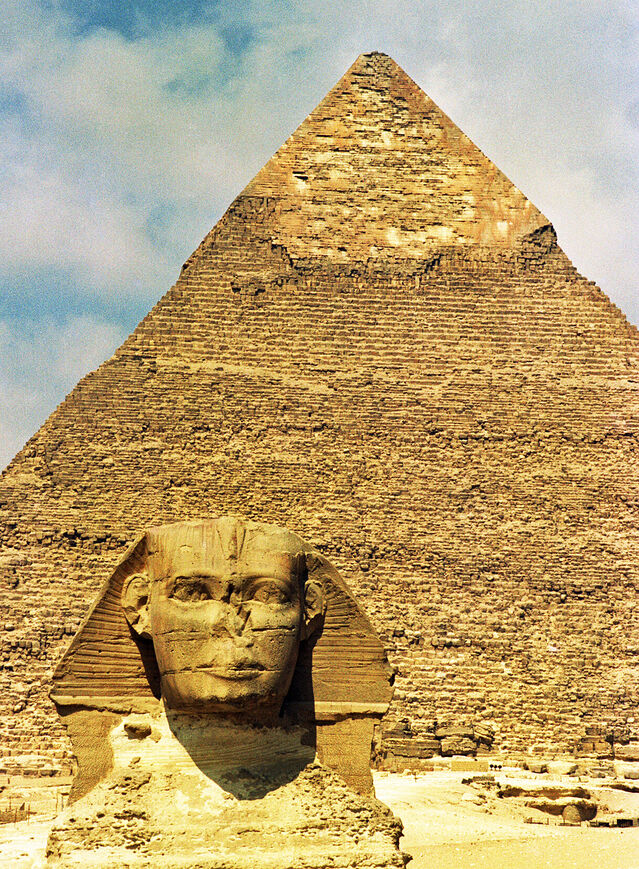 Contrary to ancient-astronaut belief, the Egyptians were fully capable of building their pyramids without alien assistance. Source: Guy P. Harrison
Over the years, numerous professionals, from the late astronomer Carl Sagan to popular archaeologist Ken Feder, have dismantled von Däniken’s claim piece by piece. The core problem is that von Däniken and others imply that possibilities and unanswered questions are sufficient substitutes for scientific evidence. But they aren’t.
A stone carving could depict a Maya ruler piloting a spaceship but it’s probably a Maya ruler falling into the underworld—as the professionals who study Maya culture concluded. Lines on a desert floor in Peru might be an interplanetary runway but are more likely to be cultural symbolism or religious art. A tribal headdress may represent ancient space helmets, or maybe it’s just a tribal headdress. And, yes, the ancient Egyptians were smart enough to build their own pyramids.
Skeptic researcher Jason Colavito has done excellent work on the ancient astronauts claim, showing not only that the belief is hollow but that the idea is not original to von Däniken. Earlier writers including H.P. Lovecraft wrote fictional stories that would feel very familiar to Chariots of the Gods? fans. I dedicated a chapter to ancient-astronaut “theory” in my book, 50 Popular Beliefs That People Think Are True. Skeptic magazine and Skeptical Inquirer have many relevant articles available through their online archives. The answers are out there. And yet it lives.
One aspect of this belief that merits close attention is the notion that prehistoric/ancient people were not intelligent and creative enough to do what they did without extraterrestrial help. Consider these excerpts from von Däniken’s Chariots of the Gods?:
- “In the Subis Mountains on the west coast of Borneo, a network of caves was found that had been hollowed out on a cathedral-like scale. Among these colossal finds, there are fabrics of such fineness and delicacy that with the best will in the world one cannot imagine savages making them.”2
- “The Great Pyramid is a visible testimony of a technique that has never been understood. Today, in the twentieth century, no architect could build a copy of the pyramid of Cheops, even if the technical resources of every continent were at his disposal.”3
- “Where did the narrators of The Thousand and One Nights get their staggering wealth of ideas? How did anyone come to describe a lamp from which a magician spoke when its owner wished?”4
- “It is an embarrassing story; in advanced cultures of the past, we find buildings that we cannot copy today with the most modern technical means.”5
Savages? We can’t build a pyramid today? An embarrassing story? In reality, our ancestors were fully capable of doing everything they did without help. Anatomically modern humans have been around for more than 300,000 years. This means that human brains, with their great powers of analysis, problem-solving, and imagination, have been doing remarkable things for a very long time.
Media Essential Reads How TV Lies to Us About Romance and Attraction
 Do UV Tanning Beds Really Prolong Lifespan?
The continuing popularity of ancient-astronaut “theory” is helped in large part by the success of a documentary-style television program on History (formerly the History Channel). “Ancient Aliens” has been running for more than a decade, totaling 15 seasons. It can be entertaining, exciting, and at times compelling, but the structure and presentation are misleading at best. A common tactic, for example, is to confidently present a false premise or factual error that leads viewers to what seems to be the only logical conclusion—aliens!
The show certainly has made a mark on pop culture. There are millions of believers, conventions, books, even bobblehead dolls of the show’s popular ancient-astronaut expert Giorgio A. Tsoukalos. The History network describes him as half Carl Sagan and half Indiana Jones.6 Social media enthusiasts are likely to know him best as the hairdo that launched a million memes.7 The History website even offers fans a computer game with the following description: “Help Ancient Astronaut Theorists uncover the truth about alien visitations in our remote past as you abduct humans, alter their DNA, and build the pyramids.” Sounds like fun. But fun doesn’t mean real.
Whenever the ancient-astronauts claim comes up in interviews and lectures about critical thinking, a fair question I’m often asked is, “Who cares?” What is the harm if some people get excited by a story of alien visitors long ago and choose to believe it?
There are two primary reasons it matters. First, falling for this is a symptom of poor critical thinking skills, which is a threat to anyone’s health and safety. If von Däniken or Tsoukalos can convince you that extraterrestrials inspired Plato’s Atlantis and your genome has ancient alien fingerprints on it—without evidence—then you may also be highly vulnerable to being hoodwinked by crooked politicians and swindled by snake-oil salesmen, with real-world consequences.
The second big problem is that this belief distorts and detracts from the real human story, the one told by credible evidence. This is not trivial at a time when our species is growing rapidly and becoming more technologically powerful while also continuing to struggle with violence, ethnocentrism, racism, and scientific illiteracy. We are unlikely to solve our biggest problems until we accept the scientific discovery of ourselves and consistently value a reality-based worldview. But for millions of people, this is more difficult than it should be because they have been seduced by fictions such as the one that says ancient astronauts were at the center of our shared past.
Recommended reading
- Frauds, Myths, and Mysteries: Science and Pseudoscience in Archaeology, by Kenneth L. Feder
- The Past in Perspective: An Introduction to Human Prehistory, by Kenneth L. Feder
- The Cult of Alien Gods: H. P. Lovecraft and Extraterrestrial Pop Culture, by Jason Colavito
- 50 Popular Beliefs That People Think Are True, by Guy P. Harrison
- Think: Why You Should Question Everything, by Guy P. Harrison
- Ancient Astronauts, Cosmic Collisions, and Other Popular Theories about Man’s Past, by William Stiebing
- The Space Gods Revealed, by Ronald Story
- Patterns in Prehistory: Humankind’s First Three Million Years, by Robert J. Wenke
- Archaeology for Dummies, by Nancy White
- Skeptic magazine
- Skeptical Inquirer magazine
- Skeptic researcher Jason Colavito’s website