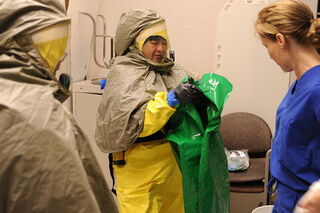
 HAZMAT incident in Toronto. Source: Wikimedia Commons
With movie theaters closed, film-on-demand and streaming services began to fill even more of our time than before. Tiger King came along at the perfect time to offer people some escape and distraction with its tale of people more outlandish and troubled than most other people. This was in line with the now-dated term Jerry Springer effect, which refers to how watching such stories helps most feel better about their own lives — because no matter how bad their own lives are, those others have it worse and have chosen to deliver the drama.
Part of their appeal lies in the fact that, despite the human side of all those stories, they are remote from our own lives. Boals and Banks (2020) note that once stress and anxiety cause a person's mind to wander, their worries will compete with other thoughts, activities, and needs for limited cognitive resources. Distraction from stress-inducing events that make a person feel helpless can be a valuable thing.
Why, then, would outbreak stories attract people during a time of pandemic? As much of the world went into lockdown, films such as Outbreak and programs such as Pandemic surged in views. Why? Is this about the strange allure of the apocalyptic? Were viewers seeking entertainment, escape, engagement, education, or something else?
All of those stories offer hope. Regardless of a story's outcome, viewers ride along and experience the journey with characters who hope to avoid disease and fix the world. Because blockbuster movies probably offer happy endings, hope does not feel futile. These tales also promote the feeling that something can and will happen to save the day. Hope and optimism offer benefits for both psychological and physical health (Snyder, 2003).
"We can watch these narratives and say if we would or wouldn't do this or that," says psychologist Eric Wesselmann. "There's a safety in that. It's predictive control — 'I think I would do this.'"
 Source: Wikimedia Commons
Mental rehearsal helps people prepare for emergencies and other situations. Watching or reading stories may provide a form of mental rehearsal. A story about a fictional outbreak can help people contemplate preparation and response in a more comfortable way because the disease in the story is not a real threat to them. The story does not depict their own lives. It does not show their own loved ones in danger.
During the pandemic, the disease topic lingers in their thoughts and can intrude upon other thoughts, so some people feel better by engaging themselves in semi-diversion by stepping outside the real danger while still exploring related issues and following a story. When it feels okay to let stray thoughts of the real crisis intrude here and there, as opposed to an attempt at complete distraction by watching funny cat videos in which such stray thoughts would defeat the purpose, the reduced stress over such thoughts actually gives them less power and lowers the likelihood of obsessive intrusion.
After the 9/11 attacks, video rentals increased for movies about plane hijackings such as Passenger 57 and Con Air. The Ray Liotta filmTurbulence performed poorly at the box office but suddenly rented well. Whereas filmmakers may have had trouble shooting fun hijacking adventures right after 9/11, people wanted to see heroes defeat murderous hijackers.
THE BASICSDiscussing such fiction allows people to talk to each other about issues that weigh on them but in a safer, more comfortable way. That does not mean a therapist should necessarily prescribe such viewing or reading to a client, no more than the clinician should assume that everybody will enjoy parachuting or golf. For some people, film material could conceivably worsen stress symptoms (de Araújo et al., 2019), but others clearly find something beneficial about it, or even "comforting," as one person told me.
Related Posts