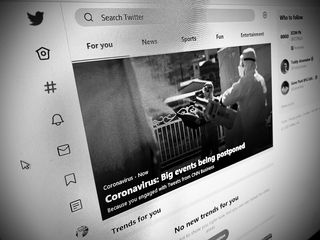
 Coronavirus fears and social media Source: Matthew Libassi/The Feinstein Insitutes for Medical Research
Unfortunately, the term viral and social media has taken a whole new meaning.
As COVID-19, aka the coronavirus, continues to spread across the globe, the headlines, statistics, and in turn, social media seem to be ratcheting up the public's anxiety. This crisis is something on everyone's mind, and it is causing a certain level of distress for all of us, particularly those with mental illness who may be more vulnerable to the stress and worry. To say the least, it's triggering.
As loving family members or friends, now is the time to give extra care and support to those we know struggle with mental wellness. We need to be supportive of our patients, friends, and family who may have underlying concerns related to anxiety, low mood, or those struggling with psychiatric disorders such as obsessive-compulsive disorder, bipolar disorder, and schizophrenia. Now is the time to help each other manage excessive stress and to encourage healthy conversations, discussions, and reassurance whenever possible.
For folks with mental illness, and without, it's key to keep an eye on how the news is affecting one's social relationships, their work, their daily ability to live their day-to-day life. If it seems to be impacting a person's typical behavior, it may be time to intervene. Keep the conversation going!
If it seems that fears and worry are becoming unmanageable, talk to your clinicians, and make sure you have access to the most factual information. We only have power over what we can control, and that all starts with the information we are reading.
For those with or without mental illness, we all have the same access to information on the news or in our social media feed. It's up to us to understand where that news is coming from and ask the most critical question: Do I trust the source? I applaud Facebook for rolling out the useful "Information" tool on their feed. If you see a news story shared, hover over the "I" on the post to see what the news outlet is when it was founded, and other relevant information.
Part of the challenge with social media, and this topic is we are getting inundated with headlines, videos, memes. Some of it is accurate, much of it is purposefully hysterical. You know yourself. You know your loved ones. If scrolling through your Facebook feed is putting a knot in your stomach, it's time to disconnect.
Here are a few suggestions on how to manage your social media use in this high-stress time:
- Turn it off. Don't be afraid to turn off the notifications, unplug, or unfollow individual connections if they seem to be alarming. It's not permanent; you can always revisit that online friendship once things have calmed down.
- Go beyond the headlines. Often, the "clickbait" headlines are crafted to spark emotion and click on the story. But, it is crucial to understand the context of a news story, not just the headlines.
- Know the source. What source are you getting your news? Make sure the news you are consuming is from a trusted, well-informed outlet. Not just a friend's Facebook post!
For more information, the American Psychiatric Association suggests some other helpful things you can do during this trying time.
Be willing to take a news and social media break in this time of high anxiety, and be sure to keep an eye on your loved ones and friends who might be dealing with mental illness. Be a resource of calm and an anchor to reality for ourselves and each other.
Remember, we are all in this together.