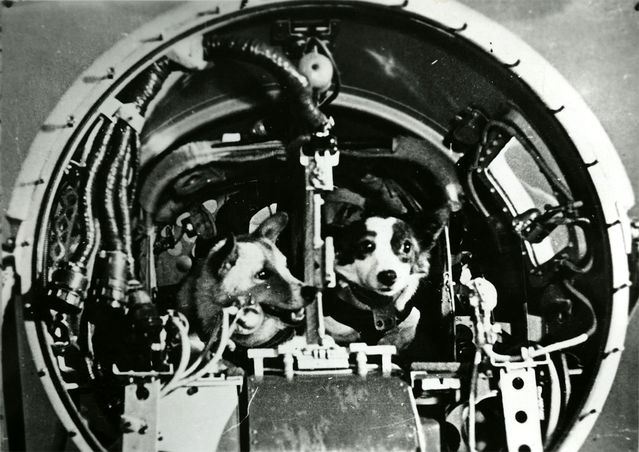
 Belka and Strelka Source: Courtesy of the Russian Embassy-UK
Do you know that the first living earthling to orbit the earth had four legs and a tail? We are so accustomed to the idea of men in space stations and even walking on the moon, that it is hard to believe that there once was a time when there were grave doubts about whether humans could survive outside of the Earth’s atmosphere.
There was a long list of potential problems that scientists were concerned about. For instance, many forms of radiation that might be harmful to living things are filtered out by the miles of air that cover our planet. There were fears that the absence of gravity might wreak havoc on our vestibular system (which is responsible for our sense of balance) and result in nausea and vomiting which might completely incapacitate an individual. There were other concerns as well, plus a simple fear of the unknown that worried space scientists and kept them awake at night.
After World War II, the exploration of space became a worldwide passion and a great political issue. America began by snatching up German scientists and rocket technology (focusing on the V2 rocket which was originally designed to be a ballistic missile and carry explosives). However, the Soviet Union had also captured German scientists and had the same technology. Both the U.S. and the U.S.S.R. were striving to be accepted as the greatest superpower in the world, and part of this involved demonstrating their advanced scientific and technological accomplishments. It soon became clear that the symbolic winner would be the first nation to conquer space, to place a man in orbit and to walk on the moon. The great “space race” was on with the reputations of both nations and their national pride hanging in the balance.
Canine Riders to the Sky
Because of those fears that space might be lethal to living things, the first living organisms that were intentionally launched into space were some fruit flies and kernels of corn. These took a suborbital jaunt on an American V2 rocket in 1947. However, on July 22, 1951, the Soviets astounded the world when they sent two dogs, Dezik and Tsyganka up to edge of the atmosphere then had them leave the rocket in ejection seats and float safely back to earth. Both dogs were healthy and unharmed. Tsyganka (Russian for Gypsy) was retired from the program and adopted by the Soviet space scientist Anatoli Blagonravov, who would later become well known for his efforts toward achieving peaceful international cooperation in space research. Dezik was not so lucky. Some two months later he took another suborbital flight with a dog named Lisa, and neither survived.
The Soviets eventually used 21 dogs in suborbital flights, reaching heights of nearly 500 kilometers. The Russians next shocked their U.S. counterparts by placing the first satellite in Earth orbit, Sputnik 1. While the world was still buzzing about that accomplishment, they topped that triumph by managing to put the first living creature from Earth into orbit. Sputnik 2, launched on November 3, 1957 carried a dog—the Samoyed/terrier mixed breed, Laika.
Why Dogs?
There were a number of reasons why dogs were chosen for these experimental flights into space. For example, dogs are well suited to endure long periods of inactivity, they are intelligent and adaptable. Their physiology is closer to humans than that of many other species, including rats. Also, the Russians felt that there had to be lots of publicity around each new accomplishment in order to convince the world that they had the most technologically advanced space program in the world. A dog is a more impressive spacecraft passenger than rats or mice. Furthermore, they can be placed in front of television cameras and made to bark into microphones, which was what Laika was called upon to do prior to her flight. In truth, Laika’s publicity activities and the timing of her mission was personally orchestrated by Prime Minister Nikita S. Khrushchev. He wanted her flight into space to be part of a gala celebration for the 40th anniversary of the Bolshevik Revolution.
Only mixed breed dogs were used for the flight program because the Russian scientists felt that purebred dogs might suffer from certain genetically related health problems. All of the dogs in the programs were actually stray dogs, rescued from the streets of Moscow, rather than animals accustomed to living in a house. This was preferred because the researchers felt that these dogs would be able to tolerate the rigors and extreme stresses of space flight better than other animals that may have lived a more comfortable life. Only female dogs were used since they do not have to lift their leg to urinate, and it is easier to design equipment to collect urine and feces for them.
The First Orbital Canine Cosmonaut
Like the human cosmonauts that would follow them, all of the dogs in the program were trained for the rigors of orbital flight. As part of their training, they were confined in progressively smaller box-like containers, and the confinement times were increased until durations of around three weeks were reached. They were trained to remain motionless for long periods of time while wearing spacesuits. They were placed in simulators that provided noise and shaking much like that of a rocket during take-off. In addition, they were given rides in centrifuges to simulate the increased gravitational force associated with a high acceleration rocket launch. They also learned to eat from a dispenser that provided them with a nutritious jelly-like protein and to drink from a special fluid dispenser.
Laika had some additional training. Remember hers was an image-building political mission, as well as a scientific one. So she had to learn her new name Laika (meaning Barker) because the foreign press was having difficulty pronouncing her real name Kudryavka (Little Curly).
Laika’s trip was meant to be one way. According to Russian reports at the time, she survived for four days in good health and was euthanized by poison in her last portion of food so that she would not suffer. In 2002, forty-five years after her flight, the truth came out when the Russians admitted that there was a malfunction in the spacecraft. In reality, Laika died after only five hours in orbit, presumably due to overheating, fear and stress. The false reports were part of the publicity aspect of the flight. This was an attempt to minimize the unexpectedly bad press that the Soviets were getting for deliberately sending a dog out to die in space. Oleg Gazenko, one of the scientists responsible for Laika's death, and who admitted that he had taken Laika home to play with his children, has said, "The more time passes, the more I'm sorry about it. ... We did not learn enough from this mission to justify the death of the dog."
Health Essential Reads The Patient Safety Risk Model
 Is Vitamin D Supplementation an Evidence-Based Practice?
Why There Were No American Astromutts
A space physiologist who worked with NASA once explained to me why the Americans never used dogs in their space program. “We told the public that we were using monkeys because they were closer to humans in their physiology and behavior. We even broadcasted films of Ham, a chimp, pulling levers for treats in a spacecraft in 1961. We said that this demonstrated the ability to perform tasks in space which was why we chose primates. Actually we could have had a dog doing tasks in space just as well. The real reason that we didn’t use dogs was because of the kind of public response that resulted when Laika died in orbit. There was real public outrage over the death of that dog. People don’t like it when a monkey is killed in an experiment, but nobody lives with a monkey so their response is kind of bland and academic. When it comes to dogs, however, there is a real emotional response. People can imagine the ‘victim’ being their own pet. We needed public support and letting a dog die in space seemed like a sure way to damage NASA’s reputation.”
Strelka and Belka
The Russians did manage to pursue their advantage in the space race, and at the same time regain some favor in the hearts of the people when Sputnik 5 was launched on August 19, 1960. The passengers this time were two dogs, Belka (Squirrel) and Strelka (Little Arrow), plus forty mice, two rats, some flies and a selection of plants. These animals spent a full day in orbit and then the spacecraft's retrorocket was fired. The landing capsule and the dogs were safely and speedily recovered and the passengers became the first Earth-born living animals to survive orbital flight. To the delight of the world, the dogs were paraded in front of television cameras and shown to be happy dogs in obvious good health.
Strelka would provide further good press for the Soviets. In June 1961, there was a summit meeting between President John F. Kennedy and Soviet Prime Minister Nikita Khrushchev in Vienna. At dinner one evening, Khrushchev was seated next to the president's wife Jacqueline, and he was bragging about the flight of Strelka and Belka. He went on to announce that Strelka had just given birth to six healthy puppies proving that space flight was safe. Mrs. Kennedy laughed and said, “Oh I bet that our daughter Caroline would love to have one of those pups.” Two months later the Soviet Ambassador Mikhail Menshikov showed up at the White House with a little white puppy named Pushinka (Fluffy) from Strelka’s litter.
When Pushinka arrived the Kennedy children immediately wanted to play with her. The cold war mentality pervading the White House, however, prevented that from happening. The Secret Service was certain that dog had been implanted with some sort of transmitting device to spy on the president’s activities, or even worse some sort of lethal biological implant which might ultimately spread infection through the first family and the White House staff. So they turned the dog over to the CIA who were going to kill and autopsy the dog. The president was horrified. Killing a dog with such a famous mother, and who had been given as peace offering from the Russians to his children would have been a public relations disaster. So instead the dog was sent to Walter Reed Hospital for examination. She was poked, prodded, scanned with a magnetometer, tested with thermography, had X-rays taken, and even subjected to an early version of a sonogram. All they found inside of Pushinka was the usual "doggy stuff", so she was returned to the White House.
The Last Dogs in Space
The last Russian dogs to fly in space were Veterok (Breese) and Ugolyok (Little Piece of Coal). They were passengers on the bio-satellite, Cosmos 110, which was launched on February 22, 1966. The dogs were observed in orbit for 22 days via video transmissions and biomedical telemetry. The spacecraft then returned to Earth safely with the dogs in good health. This still stands as the canine spaceflight duration record and was not surpassed by humans until the flight of Skylab 2 in June 1973.
After Cosmos 110 dogs were removed flight status in the Russian space program. There were several reasons. The one that was issued to the media was that enough had been learned, and it was now established that mammals can live and work safely in space conditions for long durations.
The other reason simply had to do with publicity. Of the 13 dogs that had been sent into space in the Soviet orbital program, 5 had died. Each death of a dog brought a storm of resentment toward Russia and their space program.
Last but not least, to minimize any damage to Russia’s reputation caused by the use of dogs in their space program (or perhaps I am being too cynical, and the Russian people simply had strong sentiments about the use of dogs in space and such pride over those that survived) a permanent exhibit was set up at the Memorial Museum of Cosmonautics in Moscow. The bodies of Belka and Strelka were artfully preserved and Belka can be seen in a glass case at the museum at any time. Strelka still gets the chance to go on long journeys and is often on tour as part of museum’s traveling exhibition. The names of all of the dogs that flew in the Soviet space program are listed as part of the display and the heading designates them as “canine cosmonauts” and “national heroes.”
Copyright SC Psychological Enterprises Ltd. May not be reprinted or reposted without permission.