 Source: Sam Louie
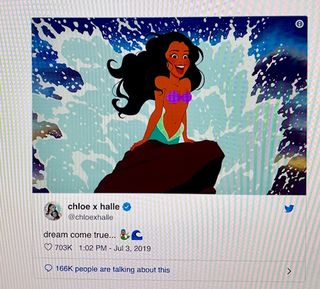
As an Asian-American and, more broadly, a person of color, Disney's announcement last week of casting Halle Bailey, a black actress and R&B singer, to play Ariel in the upcoming film and remake of "The Little Mermaid" was one that I celebrated. Disney states that this is the first time the company has selected a woman of color to play a traditionally white princess in one of its live-action adaptations. The 19-year-old actress called the casting a "dream come true" on Twitter, tweeting a photo of herself as a cartoon Ariel.
Celebrities such as Mariah Carey and Halle Berry praised the move. But it also prompted protests on social media where hashtags such as #NotMyAriel and #NotMyMermaid voiced their concerns. Their argument is that the Little Mermaid is a Nordic tale and one where the mermaid should be reflective of her ethnic origins.
But if this was truly a crusade to ensure Hollywood roles are given to those who reflect the race and/or ethnicity of the characters, why aren't these same protesters upset when ethnic roles are given to mainstream white actors? Scarlett Johansson took the role of a Japanese character, Motoko Kusanagi, in the 2017 film Ghost in the Shell. In 2015, Cameron Crowe apologized for casting Emma Stone as a part-Asian character in the movie Aloha after Asian activists, native Hawaiians, and others criticized the movie for its overwhelmingly white cast despite the movie being set entirely in Hawaii.
When it comes to Asian representation in Hollywood, Guy Aoki of the Media Action Network for Asian-Americans summarizes it best: "It's so typical for Asian or Pacific Islanders to be rendered invisible in stories that we're supposed to be in, in places that we live".
White-washing is the term used to describe the Hollywood practice of casting white actors to play ethnic characters or characters in general regardless of ethnic identity. I remember the backlash and harassment John Boyega, the Black British actor cast as a stormtrooper in Star Wars: The Force Awakens received when audiences couldn't handle a Black stormtrooper: "I was reminded of my color in a way that had nothing to do with the helmet. It doesn't matter where you go—a few ignorant individuals will come in and make comments about your race".
Back to The Little Mermaid, one might think the "right" position is to cast a white woman based on my prior line of reasoning. I would argue otherwise. Movie producers have a responsibility to create and cast characters that reflect the diversity in our society otherwise the message to non-whites is that we don't matter, we don't count, and we aren't seen. Kudos for Disney for this casting and for shedding light on the racism that can lurk in the audience.