 Source: Pixabay
A recent article in the Style section of the New York Times caught my eye. “Instagram Therapists Are the New Instagram Poets” (June 26, 2019, by Sophia June) gave me an Insta-shudder—I’m no fan of social media—but it also sparked my curiosity. Could Instagram be a helpful way to spread psychological insight at no cost to all who have access to a smartphone or screen? Or is it an alluring yet potentially dangerous and misguided approach to therapy and human growth? Or both?
Clearly, nothing is all-good or all-bad. On the plus side, Instagram “therapy” is essentially free, and in the hands of a skilled therapist and thoughtful user, it seems as benign as wandering the self-help aisle of your local bookstore or browsing Dalai Lama quotes. There may be certain use-cases that show benefit, just as texting has been found to be a useful adjunct to cognitive behavioral therapy. The Times article quotes several users who have gained at least some benefit from perusing certain therapists' Instagram feeds.
I can’t speak to what it’s like to follow any of these therapists over time, but I looked at a sampling of the feeds of all the therapists cited in the article, and I noticed several problems.
Instagram posts could well be the junk food of therapy: Addictive, insubstantial, and ultimately not that good for you.
1. Instagram “therapy” requires spending more time on Instagram.
The average American spends over two hours a day using social media. Per the best research to date, the more time we spend on social media, the worse off we are. Most of the research has been on Facebook. Time spent on Facebook is correlated with dissatisfaction with self and friends, worsened physical and emotional well-being, more depressive symptoms, and jealousy and envy (likely mediated by comparison and shame). Facebook and Instagram are correlated with dissatisfaction with body image (through social comparison), orthorexia (restrictive dietary habits, especially influenced by Instagram), idealization of thinness and other problems with body image, and substance abuse. As my previous article indicates, deactivating or taking a break from social media seems generally beneficial, especially for passive users or those prone to social comparison. Perhaps if you followed only beneficial, “therapeutic” accounts, you might be able to construct a positive resource. You might create an Insta-oasis. But even then, you would still be committing to spending more time staring at a screen, as opposed to finding rest and relationship in your natural environment.
2. Instagram therapy is nonspecific.
From what I saw, Instagram therapy posts are fairly broad, even when applied to a specific conceptualization of an issue (such as fat-phobia). When you meet with a therapist, or even when you pick up a self-help book on a particular problem or situation, you get information and relationship advice connected to exactly who you are and where you are at. There’s no problem with nonspecific information, and much of what I saw seemed to resonate with a large group of people, judging by the "likes." But nonspecific advice, “insight,” and observations can open a can of worms, and even wound us. For example, one post on “why people ghost” was enormously popular, but also incredibly controversial and deemed by many to be judgmental and not compassionate.
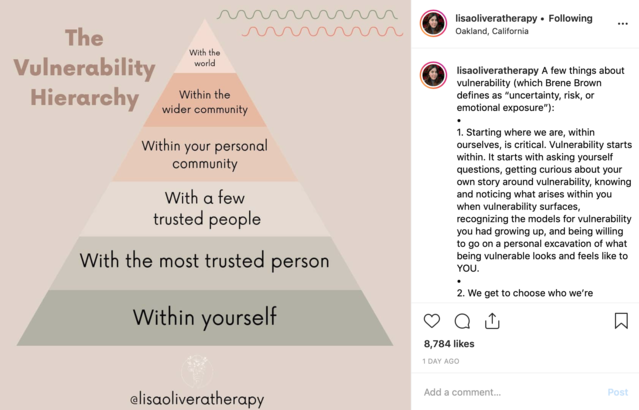 Almost 9K likes, 100+ comments - and perhaps informational. But the medium does not provide for nuance, and promotes glibness. Source: Instagram, @lisaoliveratherapy
3. Instagram therapy posts seem overly ideological and lean toward superficiality.
Posts on fat-phobia, for example, may indeed resonate with a particular group, but may also alienate those who don’t share the therapist’s ideological perspective. I’m sure @thefatsextherapist has done a lot of inner work to get to her point of view, but how might this fit with the nuances of other people’s psychologies and lives? Even something as benign as discussing vulnerability (see above) can be very one-sided, ideological, and necessarily short on nuance. These posts might be good starting points for conversation or personal inquiry, much like a blog post. But the danger is that authoritative pronouncements can represent a shortcut or “psycho-spiritual bypass” around the harder work of thinking, feeling, and growing. Feed-scrollers beware. Most people will just see the photo and not read the therapist’s explanation or users' comments. This heightens the potential for glibness and superficiality.
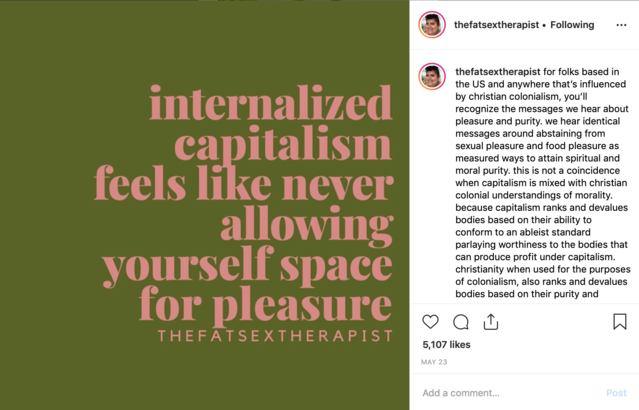 An ideological perspective that might be helpful to many, but not attuned to the individual reading. https://www.instagram.com/p/BxzFrzJguIm/ Source: Instagram, @thefatsextherapist, Sonalee Rashatwar
4. Instagram therapy posts are one-way.
These popular therapists’ posts often elicit hundreds of comments. It’s impossible for a therapist to respond to all of these. Moreover, an open comments section lends to the possibility of trolling or misinformation. At least here, on Psychology Today, I can disable and delete comments if they get out of hand. Anyone needing more communication will likely be disappointed.
THE BASICS Almost 40K likes, but opened a can of kangaroos in 2K+ comments, many of which called the post judgmental and unsympathetic. https://www.instagram.com/p/BzGrDkQgZ8P/ Source: Instagram, From @the.holistic.psychologist, Nicole LePera
5. Instagram therapy posts do not necessarily reflect the “common factors” of good therapy.
A strong treatment alliance seems to be the primary predictor of a positive treatment outcome. “It is not surprising that the qualities patients attribute to therapists in positive treatment alliances include empathy, warmth, understanding, and acceptance, and are short on behaviors such as blaming, ignoring, or rejecting… empathy accounts for as much and probably more outcome variance than does specific interventions… It might almost be said that the relationship is the treatment.” (Fulton PR, “Mindfulness as Clinical Training,” in Mindfulness and Psychotherapy (2005) eds. Germer CK, Siegel RD, Fulton PR). The Instagram posts do not purport to be relationships and might instead be viewed broadly as “psycho-education.” Yet many seem to be written in ways that are judgmental, critical, and not completely empathic. They might also be viewed as miniature opinion pieces, not always grounded in research or evidence. Not necessarily bad, but viewers must remember that Instagram posts must be taken with a grain of salt.
 This post packs in quite a lot of advice. A nuanced blog post or conversation might be more helpful. https://www.instagram.com/p/BzGtWM7ge Source: Instagram, @nedratawwab, Nedra Glover Tawwab
6. Instagram therapy posts might lead to complications and mismanagement of serious issues.
I’m sure most people intuitively know the difference between Instagram therapy and real therapy. Some therapists might post disclaimers to that effect on their posts. But people with serious issues may, in fact, reach out to therapists, and this creates a moral, if not legal, dilemma. What does the Insta-therapist do with a concerning comment or DM? We really have no guidelines yet (though the American Psychological Association is working on this).
Media Essential Reads How TV Lies to Us About Romance and Attraction
 Do UV Tanning Beds Really Prolong Lifespan?
Instagram therapy is like the Wild West. It’s uncharted territory. There already seem to be some “winners” with tens or hundreds of thousands of followers, and even book deals. It’s possible that some good may come in this new frontier. But my bias is towards relationship and depth in the IRL. I winced as I read many of these posts and worried about how some of them might be taken as Instagospel.
Spending less time on social media, and more time with friends, reading books, or at film festivals will probably yield better results for your personal growth and journey in life. And of course, finding a therapist who resonates with you as an individual is potentially life-changing.
Related posts:
- Is Facebook Destroying Society and Your Mental Health?
- Is Facebook Making Us Narcissistic?
- The Four Pillars of Mental Health and Transformation
(c) 2019 Ravi Chandra, M.D.