Habits impact results
A persistent myth about practice is that practice makes perfect. This is true only if your actual practice is perfect, since only perfect practice makes perfect.
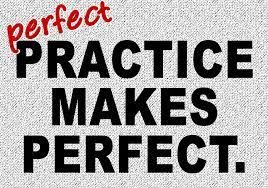 Perfect Practice Source: Google Images Public Domain
If you practice an incorrect behavior, it may become a habit that seems harmless at first. Maybe you are up too late on social media before bed. Maybe you cannot resist online shopping for clothes you may or may not plan to buy, or perhaps you indulge in unhealthy after-dinner snacking while watching a streaming channel. Such activities are seemingly innocuous, but they can become bad habits when they repeatedly steal precious time, money, energy, health, and even happiness.
Bad habits, such as the habit of imperfect practice, are most effectively eliminated when replaced by new and better habits. You can develop a perfect habit to replace an imperfect behavior by making and following an intentional habit replacement plan. Habit reformation includes a deliberate process whereby new behaviors become automatic. For example, habituated smokers may instinctively reach for a cigarette the moment they awake. Alternatively, if you step into your running shoes and head outdoors as soon as you awaken, you have a good habit. Habits can be good or bad, and habits can be changed through intention and perfect practice.
Through the years, I have studied habits, researching methods of habit correction, and have written about the habit-replacement loop (HRL) as a strategy for creating positive habits. A loop is a cycle that is repeated until the response becomes automatic. (Luskin, 2017)
The three primary requirements in forming positive habits are 1) attention, 2) focus, and 3) consistent, purposeful repetition.
Enhance your vision for your best life
If you want to develop a new habit or replace an existing habit, the best practice is to replace one habit with another. Repetition creates and establishes habit memory. Repetition loops create memory, thereby embedding the behavior that creates an automatic habit response.
The good, the bad, and the ugly
Habit replacement repetition is a cognitive behavior strategy to help those wishing to change habituated behaviors such as nail-biting, thumb-sucking, muscle spasms, or stress disorders resulting from anxiety. Habit replacement loops can also help those with poor personal habits resulting from imperfect or detrimental practices. Once you identify the habits you wish to change, you can replace them with an improved behavior. For example, reinforcing the habit of regular exercise through repetition can yield both physical and mental benefits.
Desire is very important
New Year’s resolutions are wishes for change that require a degree of desire sufficient to support motivation, identification, and conscious effort. Habit observation can help you to:
- Notice the early signs of habit formation.
- Prompt a beneficial change when a negative habit is beginning to form.
- Replace an unhelpful habit with a beneficial habit. You can’t just eliminate a habit.
- Learn relaxation techniques to manage stress that may make a habit worse.
After you understand what to do, practice the techniques and responses wherever you are. You can write reinforcement notes to yourself about your progress. Notes help to create and reinforce memory. Set up a specific time and place to practice habit substitution that reinforces replacement.
It is all in your mind
 Perfectly On Point Source: Google Images, Public Domain
Reward yourself for what you are doing. Psycho-visualization is a technique that works. Visualize scenarios that are vivid and unique to reinforce your memory. Use your mind to visualize yourself repeating a perfect practice.
In The Golden Rule of Habit Change, Charles Duhigg argues that the most effective way to replace a habit is to find a way to retain the “cue” that triggered a behavior and identify and establish a new routine that leads to a new outcome. (Duhigg, 2012)
Use a “memorable trigger” whenever you are tempted to engage in a new, positive habit. Think of something you can remember, such as rubbing your arm, wrapping your knuckle on a desk, or anything you can use to produce a memorable response.
Every habit has three components: (1) a cue or trigger for an automatic behavior to start, (2) a routine, and (3) a reward. That’s how our brain learns to remember a pattern for the future.
Memory Essential Reads Shaping the "Episodes" of Our Memory
 The Challenge of Cognitive Immobility
Seven steps for successful habit replacement
- Develop awareness.
- Intentionally replace a negative habit with a positive routine.
- Identify negative triggers and substitute positive triggers.
- Find a buddy, if possible and if it makes sense to you.
- Surround yourself with people who behave the way you want to behave and use the power of the group effect.
- Visualize yourself succeeding with new and improved habits.
- Persist in practicing your new routine. If you miss a repetition opportunity, keep repeating the better behavior. It will eventually stick.
Old habits are hard to break. New habits are hard to form. The good news? Repetition makes it possible to eliminate bad habits and substitute and maintain positive new habits.
Understand that habit replacement and development is a process by which new behaviors become automatic. Automatic means that you have succeeded in establishing a new normal for yourself. And frequently remind yourself that only perfect practice makes perfect!