“If it looks like a duck, swims like a duck, and quacks like a duck, then it probably is a duck,” the old idiom goes.1 In 1739, a mechanical duck that looked, quacked, stretched its neck, stood when offered grain, ate, and defecated like a duck astounded audiences.2 They’d pay the duck’s inventor a week’s wages to watch and wonder at this machine with its hundreds of parts. How they marveled at this lifelike device. Years before Ben Franklin supposedly conducted his experiment with a key and a kite3 and nearly a century before Michael Faraday invented the electric motor,4 few could fathom how it worked or fully believe a human being could build it without supernatural assistance. Some must have been no less thunderstruck than the Westworld character Logan Delos, wide-eyed and stammering at the revelation that everyone else in the room is mechanical: “Nobody can do this. Nobody’s even... We’re not here yet. Nobody is.”5 More than a century after people paid to see that duck, scientist Hermann von Helmholtz—whose investigations in the physiology of neural impulses, vision, and hearing6 helped pave the way for psychology to emerge as a distinct science—called it “the marvel of the last century.”7
 Source: Wikimedia Commons
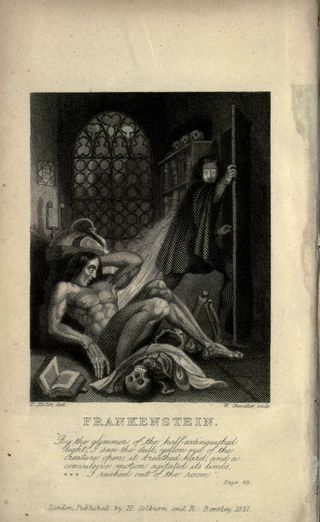
Was it alive? Not by any scientific definition, nor by most people’s personal definitions either. But as it and an array of windup wonders increased in complexity and availability, scholars began to contemplate a clockwork universe in which all natural processes are mechanically determined, even life itself.8 Then lightning struck. Inventors found ways to put electricity to work, Galvani concluded that nerve impulses were electrical,9 and scientists of the day began to ponder whether electricity could power both mechanical and living things. Soon young Mary Wollstonecraft Shelley captivated and horrified readers with a work many consider to be the world’s first science fiction novel,10 the tale of a conceited scientist who builds a man, brings him to life, and then rejects his own creation for not looking pretty.11 Victor Frankenstein’s greatest sin is not that he built the creature, but the fact that he saw the man he made as a creature and shirked responsibility for his monstrous-seeming child—two hundred years before Westworld's Dr. Robert Ford admits that his personal desire had kept him from perceiving his creations’ personhood.12
 Source: Wikimedia commons
Between Frankenstein and Ford, a long line of other sci-fi characters have taken their own shots at creating life, mimicking life, or accidentally creating life while trying to make mimics. About halfway between them, in 1920, a word emerged: robot. In the backstory of author Karel Čapek’s play R.U.R.13 (for “Rossum’s Universal Robots”), an overconfident scientist named Rossum creates artificial people. Made not of metal and glass but instead of synthetic flesh like the hosts of Westworld, they become servants that are cheap and available throughout the world. Unwilling to think of giving up their mechanical assistance, most people ignore suggestions that the robots have souls, and soon the robots revolt. Humans die, robots die, and finally one remaining human engineer helps two robots become the new Adam and Eve.14 The story that gave us the word robot (from robota, “forced labor”15) closes the curtain on the human race and yet carries a hope that some sentient beings of our own creation can carry on—reproduction of a different kind.
If we’re so afraid of synthetic people, why do we keep working on advancements in that direction? When will our voice navigation system turn into Skynet?16 Will Westworld turn out to be another bleak look at where the human race is going, or will it offer the possibility, the hope, that through all the struggles and violence a better relationship between biological and synthetic beings appear?
I’ve visited topics of artificial intelligence and sentience before, but in the context of a faraway galaxy, a distant future, or an unexplainable apocalypse. Westworld hits closer to home, in the neighborhood of our real world. Michael Crichton’s original motion picture hit people with their fears of that time, of advancing technology as represented by robots.17 The trailer for that movie haunted me years before I finally saw the film. Even though there was no issue of true sentience or of humans becoming robots, seeing the Gunslinger’s face fall off nevertheless tapped into our primal fear of people who aren’t quite people. The 21st century television series weaves Crichton’s threads into a new tale with questions about where the line between human and machine will blur as we approach the so-called Singularity.
A bit like the park’s owners as they use Wild West scenarios to peel apart the psyches of the park guests and personnel, maybe we can peek into Westworld as a way of taking a look at ourselves.
If it looks like us. . . .
“The danger of the past was that men became slaves. The danger of the future is that men may become robots” —sociologist-turned-psychologist Erich Fromm18
“Guiding this project, I’ve learned a lot about human behavior.”—Westworld character Charlotte Hale19
Notes
1. Possibly derived from “When I see a bird that walks like a duck and swims like a duck and quacks like a duck, I call that bird a duck”—poet James Whitcomb Riley (1849–1916).
2. Singer (2009).
3. Srodes (2002).
4. James (2010).
5. Westworld, episode 2–2, “Reunion” (April 29, 2018).
6. Cahan (1993); Koenigsberger (1965).
7. Quoted by Riskin (2004), p. 633.
8. Schultz & Schultz (2012).
9. Guarnieri (2014).
10. Aldiss & Wingrove (2001); Milam (2015); Stableford (1995).
11. Shelley (1818).
12. Westworld, episode 1–10, “The Bicameral Mind” (December 4, 2016).
13. Čapek (1920/2001).
14. Genesis chapters 1–5, modern era translations.
15. Karel Čapek credited his brother Josef for creating the word (Margolius, 2017).
16. The Terminator (1984 motion picture).
17. Westworld (1973 motion picture).
18. Fromm (1955), p. 102.
19. Westworld, episode 2–10, “The Passenger” (June 24, 2018).
Artificial Intelligence Essential Reads Cognitive Superposition: Human Multitasking Meets AI
 AI Eases Our Mental Load at the Expense of Critical Thinking
Introduction from Westworld Psychology: Violent Delights (2018).
Related Posts