I had a moment of shock recently whilst perusing the ads from this year’s Super Bowl. The jolt was triggered by an advertisement for a Ram pickup truck. One normally expects a truck ad to be accompanied by virile pronouncements about how this crushing monster has enough horsepower to let you blaze your way over muddy roads in the nearby national forest, bypassing those chumps in wimpy little six-cylinder baby truckees. This ad did feature a few masculine-looking fellows riding horses and doing pushups. But it also showed people helping one another out in various ways, distributing food to disaster victims and rescuing children and puppies. And the audio track was not Arnold Schwarzenegger’s voice but Martin Luther King’s. More amazing, the words spoke of greatness being measured by having a heart full of grace and serving your fellow human being.
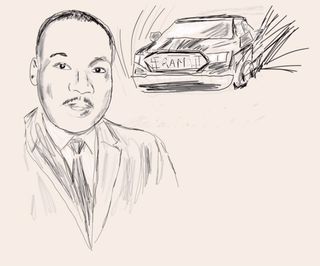 Source: Original drawing by Douglas Kenrick, based on public domain photo of MLK
If you missed the controversy, you can go online and see that the ad received a lot of criticism, being described as ridiculous, infuriating, and worse.
Indeed, there are 2,686 comments posted in response to the ad on YouTube.
I am not sure which model was splashing down the dirt road in the ad, but I discovered that the RAM 3500, with a 410 horsepower Turbo Diesel V8 engine, can be had for $46,445. You’ll need a few more dollars in your bank account for gas if you choose that version, since it gets only about 13 miles per gallon.
If he were alive today, would King really have advocated buying such a vehicle?
The particular speech excerpted in the ad was called the “Drum Major Instinct.” If you listen to that speech in its entirety (which I highly recommend), you will find it is blatantly anti-materialistic in its main message. King was complaining about how advertisers, “those gentlemen of massive verbal persuasion,” manipulate people into spending beyond their means. Indeed, King specifically talks about people stretching their budgets to buy expensive vehicles to make their neighbors envious!
Smugglers, Bunglers, and Sleuths
My colleague Robert Cialdini studies social influence, and has himself had some influence in that domain, due in large part to his ability to make clever distinctions between different types of persuasive influence. He had a paper in the journal Psychology and Marketing titled: “Of tricks and tumors: Some little‐recognized costs of dishonest use of effective social influence.” In that paper, he asks when it is ethically acceptable to use different types of influence (such as appeals to authority, popularity, or friendship). To help answer that question, Cialdini makes a distinction between what he calls bunglers, smugglers, and sleuths. An influence bungler fumbles away an opportunity to tap a legitimate source of influence (if you were trying to sell a line of rock climbing equipment and forgot to mention that you had personally used that equipment in a successful ascent on Yosemite’s El Capitan, for example). An influence sleuth is someone who deftly wields only those persuasion tactics appropriate to the situation at hand (realizing that a computer science major is likely to be more persuaded by a computer ad featuring Bill Gates than Jennifer Aniston, for example). And finally, an influence smuggler illicitly imports a principle of influence into a situation where it does not naturally belong. Martin Luther King’s voice and his words do have a great power of influence, but the words of that speech were patently not appropriate to an ad for an expensive oversized pickup truck, for example.
Is smuggling always a felonious offense?
After my initial shock, though, I considered the issue a bit more deeply, and ended up thinking that the ad, though ridiculous at one level, might have had an upside. Or two.
The first upside is that the ad led a whole lot of people, including me, to listen the King’s speech in its entirety. I had of course heard his inspiring “I have a dream” speech numerous times, as have most schoolchildren in the modern world. But the Drum Major Instinct speech is less well known, and it demonstrated King’s thoughtfulness on topics well beyond racism. He invoked Alfred Adler’s ideas about people’s need to compensate for their feelings of inferiority, by trying always to stand out in front of the crowd (like the drum majors walking at the front of the parade). And he talked about how advertisers exploited that craving for superiority, leading poor people to spend well beyond their means on products to impress their neighbors.
King’s speech connected the desire for superiority to racism, but also showed admirable empathy for the poor Whites who were persecuting King’s fellow Blacks. He tells the story of talking with the White police outside his jail cell in Birmingham. When they told him their salaries, he suggested that they should be out in the streets protesting with their Black neighbors, because they were being exploited by the same wealthy capitalists who wanted to keep down poor people of all colors.
He further spoke about how these same instincts for superiority were exploited by those who made weapons and waged war, as was then happening in the U.S. involvement in Vietnam.
The speech could have been written today, because many of the issues King discussed are still with us now. Indeed, although the basic economic position of Southern Blacks has improved, the gap between the wealthy and the poor in the United States has increased dramatically. And many of the advances made during the last century (like the societal safety nets introduced by Franklin Delano Roosevelt) have begun to disintegrate in the last few years.
The second positive side of the Ram truck ad was this: The company was attempting to associate their product not with the usual suspect motivations: driving fast, being sexy, or being tougher than others. Instead, the ad tried to tap the motivation to help other people, and to measure your own success by how much you do for others. Indeed, most of those who watched that ad probably don't have the means or the motivation to go out and buy a big powerful pickup truck, but they might have been led to think about doing something nice to help other people. And that certainly seems like a good thing.
So maybe not all acts of smuggling are equally malicious. Perhaps the Ram ad was a bit more like sneaking chocolate into a movie theater than transporting narcotic substances into a junior high school.
Related blog posts:
Pre-Suasion: Before You Try to Persuade Someone… (a review of Cialdini’s latest book)
Persuasion Essential Reads 3 Words to Win Any Argument
 How to Talk So That People Want to Listen
The 6 Principles of Persuasion: Tips from the Guru of Social Influence.
Six degrees of Social Influence: What’s so influential about Robert Cialdini
And the year’s best paper on consumer psychology is…. (encouraging conservation, one towel at a time)
Who are psychology’s geniuses? Some brilliant psychologists I have known.