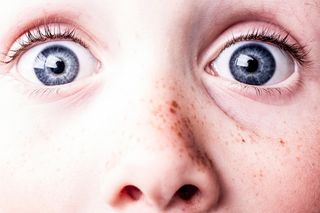
 Source: public domain - Pixabay
Scary props at Halloween can provide fun. Many people seek out scary movies for thrills. But there can be a definite downside to being exposed to frightening images.
Movies or television shows that are scary can stay in your mind for a long time, and not in a good way. Particularly those you watch when you are a child. My personal example is from seeing one of my first movies ever: Bambi, a Disney movie meant for children. I still remember my shock and horror when Bambi’s mother was shot and killed by a hunter. I also remember that the scene—together with its unpleasant associated emotions—lingered in my mind for days, for months, actually.
Can you think of an example?
Now, according to a new study, reported in the University of Michigan Record, there are even more possibilities leading to exposure to frightening images and stories. And the reactions to them can have long-term effects.
An earlier study of fear reactions to scary content
In 1999, researchers at the University of Michigan and the University of Wisconsin showed that many adults still recalled, with unease and anxiety, horror movies and disturbing television programs they’d seen during childhood and adolescence
Efforts to cope differed with age. Children escaped the room or covered their eyes. (Some of us still do this as adults.) As adults, they did a kind of cognitive therapy on themselves, using their cognitive abilities to reassure themselves that "it's just a movie" or "this could never happen in real life."
The new study of fear reactions to scary content
A new study, from the University of Michigan’s Institute for Social Research, Department of Communication Studies, has been done to extend the findings from that investigation. As reported in the University Record, more than 200 adults were asked about frightening portrayals in the media that produced unpleasant feelings lingering after immediate exposure ended.
The results?
Ninety-three percent of the adults reported they’d had such an experience during childhood. "Supernatural monsters", such as zombies and aliens, were frequently cited as the producers of fear. The effects could be serious: 39 percent said their sleeping and eating were disrupted. And there were repercussions from that original childhood fright that lasted for years.
As adults, 72 percent had a frightening experience. For teens and adults, these frightening experiences could produce nausea, increased heart rate, and fear of dying.
The study documented how additional media viewing opportunities, such as exposure to streaming entertainment videos and constantly-airing news, increase our exposure to frightening happenings. For example, the continual multi-media coverage of the violent World Trade Center attacks contributed to increased fear in teens and adults. (My own study on the impact of September 11th, 2001, as measured by the incidence of suicide attempts in Michigan, can be found at: the-terrorist-attacks-september-11-psychological-toxin)
How much scary stuff is too much?
Clearly, we humans have an appetite for scary stuff. Otherwise, the movie and TV industry would stop making it. But how much watching is enough, or too much? At what point does it overwhelm our ability to successfully cope with it?
That’s an individual decision each of us needs to make for ourselves.
THE BASICS