 Source: K. Ramsland
In 2012, Ricky Cobb launched the first of a series of conferences devoted to Jack the Ripper, hoping to draw other Ripper devotees into discussion and debate. He succeeded, and his conference continues, meeting this year in early November in the Arbor City Hotel in London’s East End.
“We hope that by sharing our knowledge,” Cobb states, “we may just help solve this most puzzling of mysteries. The conferences help to scrape away the myth and present the grassroots reality of the Whitechapel murders, the police investigation, and the social impact caused by the case.”
Although the meetings haven’t always been in Whitechapel, participants this year get to convene quite close to the Wicked Quarter Mile. Things don’t look much like they did a century ago, but Cobb says the Ripper’s crimes have the distinction of evoking an era. “If you mention his name to anyone they will instantly think of Victorian London, foggy nights, gas lamps and prostitutes.”
I’m not able to attend, but I asked him to say a few things about the conference.
It all began for Cobb in 1988, the centenary year of the still-unsolved murders attributed to Jack the Ripper. “As an impressionable 12-year-old watching the documentaries and picking up the latest books of the time,” he says, “I was hooked. The idea that the case couldn’t be solved was a great challenge to any amateur detective. It has become quite simply, the greatest whodunnit in the history of crime. In 2012, I convinced my brother, Colin, that it would be a good idea to hold our very own conference dedicated to bringing a better understanding of the case to the public attention.”
The first gathering for their conference took place in York, England.
“It was not an easy task," Cobb recounts, "because the public image of Jack the Ripper is so shrouded in myth that it becomes hard to separate fact from fiction. We have had 128 years of movies, books, and plays where the image of the killer changes, ranging from what would have been a normally dressed East-ender to the more elaborate gentleman with top hat and cloak. The feeling that he could have been a doctor, or even a member of the royal family, has glamorized the killings.”
Still, Cobb elicited a solid response.
“Among the first speakers that year was author Martin Fido, regarded by many as the leading authority on the Ripper case. Representing Scotland Yard, Laura Richards explained modern techniques that would be used in tracking the Ripper if he were to strike today. In all, we had 10 expert speakers and it was a wonderful weekend, packed with information and research, along with a great social vibe.”
Cobb’s Crime Conference, he says, has grown into the largest true crime-related gathering in the UK.
“We decided to try to involve all aspects of Ripperology, so we’ve had a mix of authors, historians and armchair detectives presenting their work to us. We then added book sales and signings, along with other true crime memorabilia. Recently, we've added an annual book award, a charity auction, and a raffle.”
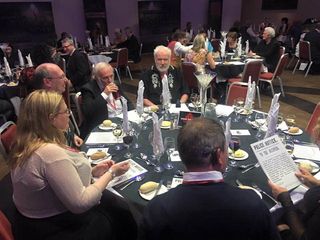 Source: Richard Cobb
Among the most popular aspects is the Saturday dinner: “We sit down to fantastic three-course dinner and wine reception with an after dinner speaker. Dress code is smart dress or Victorian Attire.”
Given the fact that books seem to pop up every year about a new Ripper suspect, there is bound to be plenty of heated discussion.
“It really wouldn't be the subject it is without some level of controversy and we've had our fair share. The most recent was Wynne Weston-Davies, a former eminent surgeon and anatomist, who believed that his great aunt Elizabeth was Mary Jane Kelly. He claimed she had adopted a new name in an attempt to escape from her husband's control, but after changing her name she became the Ripper's final victim. Weston-Davies was determined to exhume Mary's body to find out the truth through DNA. This caused all sorts of mixed feelings and raised many academic and moral questions.”
Since the conference is so close to the Ripper sites this year, it offers a tour.
“We will certainly explore the relevant sites associated with the investigation. The guide will focus on the ‘canonical five’ [five generally accepted victims], but will also mention other possible victims. We will try and cover as much of the Whitechapel murders as possible and allow participants to draw their own conclusions. We find many of our delegates stay an extra day and do their own walk around, so I’m sure everyone will get a chance to explore the East End over the weekend.”
Law and Crime Essential Reads When Parents of School Shooters Face Legal Liabilities
 Why Gen X Parents Are Afraid of the Wrong Types of Crime
In addition, there will be some special exhibits.
“We have had quite a few exhibits and artifacts over the years. The two most well-known items were the ‘Dear Boss’ letter – the taunting letter sent to the Central News Agency that gave the world the name, Jack the Ripper – and the infamous Maybrick diary, in which Liverpool cotton merchant James Maybrick reportedly confessed to the murders. As for what we will exhibit this year, my lips are sealed. You'll have to wait and see.”
Among the speakers are Richard Patterson on his suspect, Francis Thompson; Mick Priestley addressing Red Jack as a sexual serial killer; Lindsay Siviter discussing Stephen Knight and the 'Final Solution'; and Jan Bondeson, talking about “Ripper Rivals.”
“I think the key to success,” adds Cobb, “is that we cater not only to seasoned Ripperologists but also to newcomers. Anyone with an interest in true crime can feel comfortable and can leave richer for the experience.”
Those delegates who wish to continue the social aspects of a shared interest in the Ripper can join the True Crime Club - H division, named after the police division that hunted Jack the Ripper. Every member receives the quarterly club magazine, The Dagger, which offers information, club news, and conference discounts.