Like many young people of my era, I spent an inordinate amount of time in front of the television and on the telephone, usually at the same time. While my grandparents may have huffed and puffed about my eyes and ears being continually connected to a device, my frequent use of these items was part of how I connected with my peers and developed the identities I have today. It was considered normal adolescent behavior.
 Source: Angela Patterson
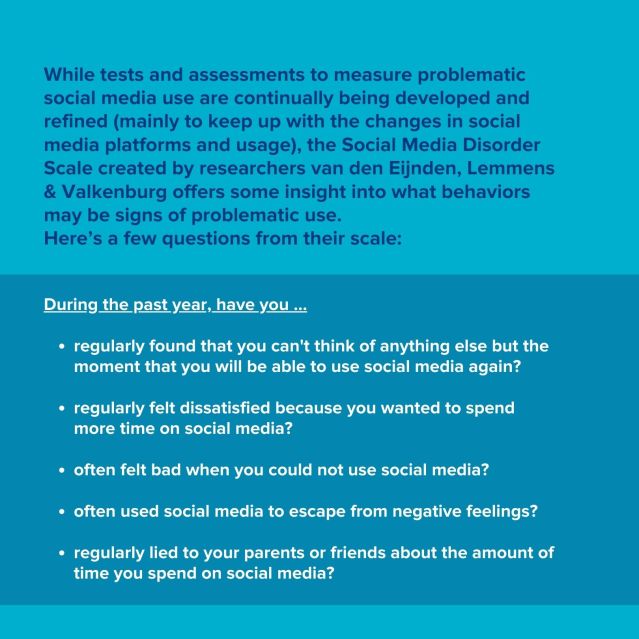
Today, teens’ frequent connection to their devices and the apps found on them is also considered normal for teens — and like anything, it can become a problem if taken up in excess and for negative reasons. In casual conversation, someone might say that a person is “addicted to social media,” but addiction is a complex disease with serious consequences — such a term should not be used lightly. The Diagnostic and Statistical Manual of Mental Disorders (DSM) and similar manuals don’t recognize social media addiction as a formal diagnosis, so using such a label can be misleading. Instead, researchers often refer to “problematic” social media use, which is where a young person is showing addiction-like behaviors that are outside adolescent norms. Problematic use differs from frequent use due to the loss of control that such a user experiences and the risk it poses for more serious psychological problems over time.
It's worth noting that social media itself is not what makes young people lose control. In their latest health advisory on social media use, the American Psychological Association says it best:
"Using social media is not inherently beneficial or harmful to young people. Adolescents’ lives online both reflect and impact their offline lives. In most cases, the effects of social media are dependent on adolescents’ own personal and psychological characteristics and social circumstances—intersecting with the specific content, features, or functions that are afforded within many social media platforms. In other words, the effects of social media likely depend on what teens can do and see online, teens’ pre-existing strengths or vulnerabilities, and the contexts in which they grow up."
This reflects a key tenet of media psychology: One brings one’s full self to media, they interact with it, and then experience positive, negative or neutral effects on the other side. Social media itself — as technical platforms or as modern modes of communication — doesn’t cause anything, but could very well tap into or magnify something that’s already there.
This also means that “taking away” social media from young people, or pushing social media companies to regulate themselves and the way they connect to users, won’t completely solve the challenges we’re seeing with these types of digital connections. Part of the answer lies in adults knowing the factors that can potentially lead to problematic social media use and taking intentional steps to counteract them.
What the Research Says
Research we’ve conducted at Springtide Research Institute has found that young people who have trusted adults in their lives report lower levels of stress and loneliness and social isolation. The importance of these trusted relationships with adults aligns with some of the latest research on problematic social media use, which shows how connection to and social support from both peers and adults — but particularly parents — can reduce the likelihood of engaging in these behaviors. This is particularly true in the earlier stages of problematic use.
The internalization of certain beliefs might also contribute to problematic social media use. Researcher Weiyu Zeng and team surveyed Chinese girls ages 11 to 16, and found that girls who had internalized thin-ideal images “were more vulnerable to social media’s addictive properties, constantly engaged in selfie-related behaviors, and developed subsequent problematic social media use.” Yet, quality friendship helped to bypass developing problematic social media use.
THE BASICSThese findings suggest ways that parents and trusted adults can help steer young people away from problematic social media use. There's no guarantee that a young person who has quality relationships or develops certain traits will bypass struggles with social media; but in having them, they may be better equipped to deal with any hardship that arises — whether it's social media or any other elements that have the potential to be problematic. Here are four concrete steps based on the research:
- Ensure that a young person is spending quality time with both parents and peers. Teens who feel like they have strong social support from parents have been found to report less problematic use. Research has shown that lonely teens use social media as a way to find connection, and those experiencing moderate and high levels of loneliness tend to misuse social media more often compared to those who aren’t feeling lonely. Helping young people to feel included and connected is a powerful way to head off problematic use at the pass.
- Help young people early on to develop a sense of self-control. Research shows that self-control may be one of the individual factors that helps to lower the risk of problematic social media use. Parents can aid development of self-control by establishing routines and creating environments where displaying self-control is consistently rewarded.
- Help young people to develop resilience. Young people navigating difficult situations or challenging internal states may adopt negative coping styles like problematic social media use. When young people develop resilience, they may have the feelings of competence and confidence that keep them from entering the mental states that sometimes lead to problematic use.
- For all young people but girls in particular — ensure that they’re developing healthy body images and senses of self. It’s common for young girls to start to take notice of body image and appearance norms before they’re old enough to use social media. Unhealthy beliefs could exist before they ever have a profile or account. If they have a good grasp of self-acceptance and positive body ideals, they’ll be better positioned to not succumb to problematic social media use around these issues.
 Reframing Adolescence: Empowering Teens Beyond Stereotypes
 Are Young Women Into Porn?
Social media has a tremendous capacity to help young people connect, grow, and learn, so healthy usage of it should absolutely be supported. And while problematic social media use can’t be completely avoided, parents and trusted adults can take steps to help young people use these tools without allowing merriment to turn to misuse.