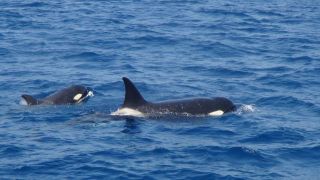
 Source: David Nieto Maceín
Numerous people have heard about the killer whales (orcas) in Spain, who are interacting with boats, because of a great deal of global press about what they're supposedly doing and why.
Having read a large number of articles and watched various videos, I'm still not sure anyone really has any definitive answers. So, I'm glad that Spanish ethologist David Nieto Maceín, who knows these whales, could answer a few questions about what might be happening and why. Here's what he had to say.
Marc Bekoff: Why are you interested in what is happening with the orcas that are attacking boats?
David Nieto Maceín: On one hand, I have an emotional bond with orcas. I have studied them for many years, although I am best known for my work on canids. I feel very close to the orcas in the Strait of Gibraltar because of my work with the late orca researcher, Mario Morcillo.
On the other hand, as an ethologist with strong interests in animal cognition and emotions, I have a special interest in cetaceans, especially orcas, and their interactions with boats are very interesting because they inform us about imitation, cultural transmission, complex cognitive behaviors, and that species with very highly evolved behavior patterns constantly generate patterns of social behavior that force us to try to figure out what they are doing and why. The orcas are an ethological challenge. In addition, supposedly 'revengeful' interactions with ships have become world news and this has aroused unjustified fears.
MB: How well do you know some of them?
DNM: I know some of the orcas from the meager population in the Strait of Gibraltar, although I am not the one who knows them best individually. I receive information from friends who spend more time with them than I do.
MB: Are the orcas being revengeful, playful, or both?
DNM: Sometimes it is not easy to distinguish the difference between play and aggression in animals like wild cetaceans. But some patterns do reveal differences. The problem is that there are components of both types of behavior.
I don't know if it would be correct in any case to speak of revenge. Revenge is the satisfaction that is taken from causing damage. If the orcas are responding to past injuries, it is not in search of satisfaction but rather, as their behavior indicates, to avoid being harmed by behaving aggressively. This irritating behavior could have been turned into something that is revengeful and even playful. It is very interesting because we are talking about the same complexity that we observe in humans.
It's also interesting and important to note that other orcas have learned to do the same things and the behavior has spread contagiously. So, as you rightly have pointed out, it can be both: Behavior in response to past injuries they received from sailboats and playful 'vandal' behavior, just like in humans.
MB: Is there anything that has or is happening about which most people are unaware?
DNM: These killer whales develop many incredible cognitively complex techniques to catch giant red tuna that are culturally transmitted among them. Mario Morcillo thought that tuna fishing began thanks to orcas and symbiosis with humans. Currently, the orcas rip off some pieces of tuna fished by small Moroccan boats. The interactions are friendly and the orcas are careful not to capsize their small boats. At first, I thought it was just a game of teenagers—two orcas who were starting to break rudders for fun, a new behavior that stopped when they returned from their migration to the Northeast Atlantic. But we also know that these orcas had been wounded by boats.
It could also be playful behavior but when you analyze some videos, some behaviors appear to be more violent. Of course, it could be playful behavior that escalates into aggression. The truth is that the orcas have continued to be harmed by some fishing boats.
Some orcas have also been killed. It is very likely that the 'vandalism' has to do with a response to these aversive experiences. Of course, the orcas mean no harm, as they just grab the rudder and snap it, bringing the ship to a stop. Some boats have sunk because of leaks caused by blows that have been delivered by orca snouts. In any case, the aggression was short-lived. The orcas could sink any of these sailboats in a few minutes but they don't. They also don't hurt people.
MB: Is there anything else you would like to tell readers?
DNM: Orcas have well-developed cultures that allow them to share sophisticated patterns of behavior that develop in new situations for solving new problems. They also transmit messages with their own dialects and imitation is quite common. Orcas also have a strong influence on the ecological dynamics of other predators, which is why they are vital members of marine ecosystems.
Animal Behavior Essential Reads The Eclectic Father of Cognitive Ethology
 "Thinking Like a Wolf": Pack Politics, Power, and Personalities
It is important for people to know what is actually happening in the water because erroneous, biased, or sensational information does a lot of damage and defies reality. Journalists on television programs and newspapers have generated absurd and unjustified fears.
So, are the orcas being revengeful or playful? It's difficult to know and it likely is a little bit of both. There is no reason why these cognitively and emotionally complex animals can't combine these two reasons to drive their behavior, and that is why it's essential to pay close attention to context to figure out what they are doing and why. I'm not sure we can ever cleanly separate these two motivations, but I hope that more research will help us understand why the orcas have decided to do what they're doing at any given moment. There might not be any single explanation and what they choose to do likely depends on which whales are involved and context.