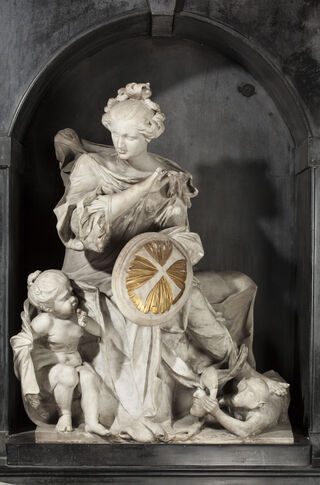
 Veritas Source: Public Domain {{PD-US}}
Almost every day someone tells me an unsubstantiated fact. We are living in an age where seemingly factual information comes to us with the heat of our fingertips; an age where memory relies on crutches that balance intelligence with presumption, information with speculation, reality with illusion, and logic with nonsense.
We are living in a world that accepts truth by hearsay. Rumors spread at colossal speeds, especially when they pass through echo chambers that balloon the slightest suggestion of a possible fact—not a fact—to make it go viral. A quote with a missing apostrophe or a tweaked impostor word squeezed in can contradict a fact.
As in a circus act, outlandish ideas grab attention. Content spreads fast because one person shares a site with multiple people, inadvertently creating an exponential viewership. Much of it is about attention-grabbing so advertisers can promote what they have to sell.
There are subscriptions to be sold and advertisements to be gained, but it’s not always about money. Some nobodies want to be somebodies, and others feel that attention creates power and celebrity. There is nothing new about this. For centuries, Machiavellian aggressive behavior distinguished followers from the followed. Every century has had more than its share of tyrants and despots. But this twenty-first has made it far easier for eager opportunists to become recognized and wealthy, in many cases far beyond their worth.
Twisted Facts
This century has more than its share of twisted facts. The smartphone that hardly leaves your side is learning everything it can about you, what you buy, what news outlet you prefer, who your friends are, and the books and movies you favor. I’m not suggesting that Big Brother is watching; I leave that thought to others who’ve said as much. But you notice that when you browse online for almost anything you intend to buy, advertisements pop up in nearly all your searches for the next few days. It’s no coincidence.
Search engines create personalized recommendations based on past searches. The same goes for news preferences. Your history tells Google that you have been reading liberal accounts of news, so your future hits will be news organizations that fit your intellectual style and reasoning. If you have been reading fake news, then fake news will continue to be high on your popup list. Artificial intelligence is smart enough to hit you with highly realistic material spreading all the disinformation you are prone to learn. Reputable articles can appear as if written by authentic accounts when they are the work of bots and trolls paid to spread fake political points.
If you have been reading The New York Times, your news searches will follow in the realm of significantly intellectual fact-checked news. But up against it are those impostor organizations that look and sound as if they are fact-checking news outlets when, in reality, they are scripted propaganda units built to hold our attention.
In Science, Truth is Called "Fact"
Truths and falsities are accessible from objective reality mixed with ambiguities of meaning that can undermine facts. Unlike mathematics, where researchers can have opinions and make conjectures before proving them beyond doubt, science works differently. Generally, truth does not come from ironclad links of deductive logic. For any study to be called scientific, it must replicate through independent experiments. It must rely on vigilant observations avoiding biases and contaminants in scientific research that can lead to false results.
THE BASICSScience starts with curiosity and observation. Opinion can lead to hypotheses tested through experiments in the physical world of observable data that refine the theory. Observational data, though, is tough to analyze as it passes through gauntlets of a researcher’s conventional behavioral traits. There are always inherent tendencies to scour data for prejudiced conclusions, to miss hidden variables through conformational bias, and to misjudge statistical tools and methods. Fortunately, biased inferences are rare, even though concluded truths—under the scrutiny of the most careful scientific research—are not as locked with the same logic as a mathematical proof.
Truth Through a Collection of Possibilities
In this age of the Internet at our fingertips, we know the truth by trust. How can one know ahead of time that something is a fact without having proof? Evidence is the answer.
But what exactly is the evidence? In mathematics, we know that evidence is logical deductions linked to established theorems. But what is evidence in, say, biology, law, economics, or even politics? There is a difference, but not much.
Attention Essential Reads Why the Limits of Language Are the Limits of the World
 Drop It Like a Squat: Exercise Breaks Can Enhance Attention
Truth involves meaning and defining; that is, one gets to the validity by building a collection of possibilities and then categorically filtering those possibilities by some elimination process questioning how well the potentials fit in our world of experience. For music and poetry, the truth comes from the spirit of our collective senses of our familiarities. For mathematics, it comes from our universal intuiting of logic.
Proof is an ultimate conviction, whereas testing statements against varied possibilities only permits one to feel convinced. Playing with options and making minor conjectures are the ingredients of persuasion.
Awakened feelings of persuasion are in many other forms of endeavor that arouse conscious inferences and possibly unconscious nuances. For art, it could be a fragrance, a sound, or a Proustian crumb of toasted corn muffin reviving forgotten experiences and awakening associational stimuli. Certain musical pieces stimulate images and thoughts stored in our cerebral cortex memory warehouses. For most of us, a musical phrase in a funeral march brings “sadness” because some elements are likely to come from the cultural-collective subconscious. In mathematics, conscious inferences are memories of clever techniques behind proofs already seen. The core of truth then depends on whether or not we recall pieces of established arguments that fit together like jigsaw linkages of if-then.