This post was co-authored by Jane Shawcroft, a master's student in Marriage, Family, and Human Development at Brigham Young University. She studies media and parenting, and the effect of media on children's gender stereotypes.
 Source: Vidal Balielo Jr./Pexels
Parents are often concerned about the potential negative effects of media on their children. Popular media tends to vilify media use, claiming that media is responsible for the mental health crisis in adolescence and young adults, and that media use hurts children’s development.
Because it is true that media can be good (thank you FaceTime) or bad (endless TV) for children, parents today face the challenging task of figuring out how they will parent around technology and media use from a young age.
Because parents did not grow up with the same access to media that their children have, this is uncharted territory for many new parents. This uncertainty has led to some variation in the styles used by parents to regulate media usage in their children.
Some parents believe extreme restrictions, such as limitations on time spent and content viewed, are the best approach (Coyne et al., 2017). Other parents take a hands-off approach. They may feel overwhelmed or that they are fighting a losing battle to restrict their children’s media use (Lo et al., 2020).
These differences in parenting approaches towards media use reflect a need for parents to better understand how they can structure their young children's media use in a way that will help support their child's healthy development. Most parents report that they want to structure their children's media use, but many do not know how to best go about it.
Our Data
To help us understand further how parents are creating rules around media use, and how they affect children’s media use and media dependence, we looked at data from Project M.E.D.I.A., a longitudinal study exploring children's development in our media saturated world.
Expecting Parents- Concerns and Plans
Expecting parents (parents who were pregnant) in Project M.E.D.I.A shared similar concerns to parents in previous studies but also reported that media could be valuable when there was educational content.
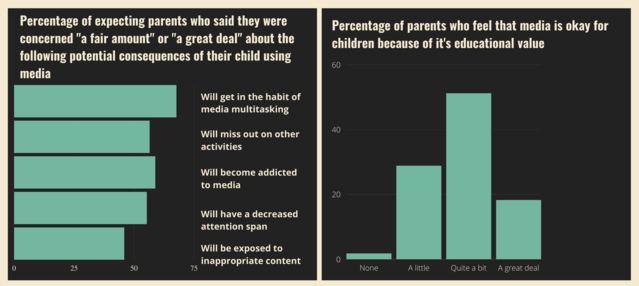 Expecting Parents- Concerns about Media Use Source: Jane Shawcroft
Almost all expecting parents said that they were planning on creating rules around their children's media use, specifically about how much time children could spend using media, what content children could interact with or view, and what devices children could use.
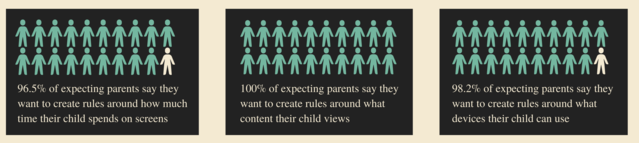 Expecting Parents- Plans for Media Rules Source: Jane Shawcroft
Parents of Toddlers: Rules and Media Time
Three years later, the majority of parents said that they had rules around what content their children could watch and how much time their child could watch TV. However, less than half of parents of 3-year-olds said that they had rules around how much time their child could play games on their tablet.
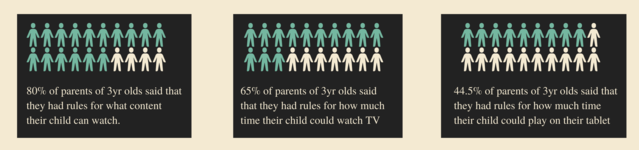 Parents of Toddlers- Rules and Media Time Source: Jane Shawcroft
Rules Around Media and Problematic Media Use
Most parents create rules around their children's media use because they want to help their children develop a healthy relationship with media, so, we examined if rules parents had about their children's media use were associated with levels of media dependence. We found there was not a meaningful relationship between parents simply having rules around media use and children's media dependence. However, there was a meaningful relationship for time children spent playing with a tablet.
While having rules around children's media use was not directly linked to children's level of media dependence, it is possible that parents who have/enforce rules around their children's media use have children who use less media (specifically using their tablet less). It is likely that the rules that parents create around their children's media use indirectly protect children from developing media dependence.
Takeaway
Most parents are concerned about their children's media use, and the majority of parents of 3-year-olds have some type of rules around what type and how much media their child consumes.
It is interesting that only 44.5% of parents of 3-year-olds reported that they had rules around how much time their child spent using a tablet, yet the only meaningful predictor of children's problematic media use we examined was the amount of time children spent using tablets. There are two possible ways to think about this finding. First, it is possible that because more parents have rules around how much time children spend watching television, TV time plays less of a role in children developing media dependence. It is also possible that tablets may play a larger role in children's media dependence because they are small handheld devices, and might isolate children more when they are using them than TV. However, the nature of tablets might also make them more difficult to parent and enforce rules around.
In addition, there was somewhat of a gap between the percentage of expecting parents who said they were planning on creating rules around what media content, and how much time they could spend using media, and the percentage of parents who actually had rules around their children's media use at age three. Parents today have a lot of different stressors, and media is so prevalent that it can be difficult for parents to control or feel like they can make any difference in how much their child uses media.
Media Essential Reads How TV Lies to Us About Romance and Attraction
 Do UV Tanning Beds Really Prolong Lifespan?
Based on our data and other research, we suggest that parents focus their media parenting with young children on limiting the time their children spend with various types of media, particularly tablets, as they seem to be a form of media closely linked to children's media dependence. This suggestion is primarily motivated by the lower levels of parents who reported having rules around children's tablet use, despite much higher rates of rules around TV and content. As many children use tablets to engage with media, this is an important blind spot for parents to watch for. While parents are concerned about media use, often wondering how to best help their child, learning more about how creating rules and structure around children’s media use will help parents feel like they have the knowledge and tools to be the most capable parents possible.