With the fast-approaching celebration of Halloween, fearsome frights and horror flicks are as much a staple as jawbreaker-related trips to the dentist. From the ghosts that swing from the trees to the skeletons escaping from graves underground, one might think the zombie apocalypse is surely close at hand.
But, more than a bloodsucking vampire or two, what really brings on a sense of fear is the jarring soundtrack that accompanies a movie scene where the supernatural killer hunts his prey. If anyone doubts the frightening effect that musical mayhem can evoke, just recall the screeching music during the shower scene in Psycho. Why does horror movie music in particular seem to make the hair stand up on the back of our collective necks?
The fear factor
In a word, human emotion. Or at least the emotion communicated by a human scream. The music that often accompanies horror movie scenes is commonly described as having a scream-like quality and it appears that it is specifically this closeness acoustically to what human screams sound like that helps push a sound into fear-inducing territory.
Inspired by a field called ethology (or the study of animal behavior) to look at how music mimics human vocalizations such as weeping or screaming to trigger emotional response, a 2020 study by Trevor, Arnal, and Frühholz explored the acoustic patterns behind the music used in horror films that made them more fear-inspiring and alarming than other sound patterns.
Using a measure called the modulation power spectrum (or MPS) which quantifies the portion of acoustic space that is heard as ‘roughness,’ the researchers found that human screams use a range of MPS similar to other danger-signaling sounds such as alarms or sirens. Sounds that exhibit this grating quality tend to provoke an aversive reaction in humans as well as trigger increased subcortical neural response.
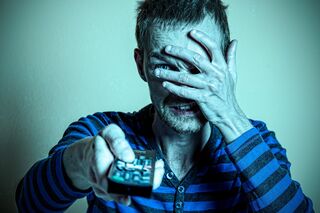 Hard to watch, but harder to hear Source: Sammy-Sander from Pixabay
Just add in some killer music
To investigate how such auditory unpleasantness ties in with people’s reaction to horror movies, the researchers looked at whether scream-like music drawn from horror flicks, the type playing just as the killer opens the closet door where the victim is hiding, had a similar ‘roughness’ measure to human screams.
As it turns out, both human screams and heart-pounding scary music make use of a significantly higher MPS range than non-screaming sounds or the music played during non-horror-provoking scenes. This suggests that the music that accompanies the most frightening scenes in movies indeed acoustically mimics the roughness quality that humans emit when they scream.
THE BASICS- What Is Fear?
- Take our Generalized Anxiety Disorder Test
- Find a therapist to combat fear and anxiety
The sound of danger
Hearing this scary music provokes an aversive fear-response because it caused both increased arousal and a more negative emotional valence among participants, as did screams. Still, they found that screams scored higher on the MPS measure than even scream-like music, suggesting that real screams convey potential danger more than ominous music does and would tend to induce more of a reaction.
So, in the end, the scariest sound may not be the screeching music as the possessed killer suddenly appears onscreen, but the shrieking screams that escape from those caught up in watching it.